A personal AI assistant that runs 24/7 on my miles VPS, reachable via Telegram. Built on ZeroClaw — a 3MB Rust binary that handles channels, memory, tool use, and model routing. Eliza is the instance; ZeroClaw is the engine.
The goal: an assistant that manages my life — or at least the digital parts of it. PRs, infrastructure monitoring, backlog, scheduling, delegation. Not just answering questions, but doing real work autonomously. She wakes up at 7am with a briefing and has opinions.
Architecture
Two repos, one system:
- eliza-config — personality, identity, context, and skills. The “who Eliza is” repo.
- nix-config (
hosts/miles/zeroclaw.nix) — builds ZeroClaw from source, manages the systemd service, and deploys workspace files as read-only symlinks from the Nix store.
Five workspace files define who Eliza is — her principles, personality, context about me, runtime capabilities, and operating rules. She can’t modify them at runtime, but she can modify them through the normal git workflow: clone, edit, commit, push, redeploy. Declarative self-evolution — she changes who she is through the same infrastructure-as-code pipeline as everything else.
Skills
Skills are contextual instruction sets loaded into the system prompt at runtime — markdown files describing when to activate and what to do. The highlights:
- morning-briefing — Daily 7am summary: system health, backup status, Linear issues, GitHub PRs, weather
- pr-review — Spawn independent review agents, address feedback, iterate until clean
- delegation — Route tasks to sub-agents by complexity (Haiku for simple, Sonnet for analysis, Opus for hard problems)
- self-improvement — Review past sessions, identify gaps, propose and deploy skill changes
Ten skills deployed in total, all version-controlled and declaratively managed. Adding a new skill is writing a markdown file, wiring it into Nix, and running make deploy-miles.
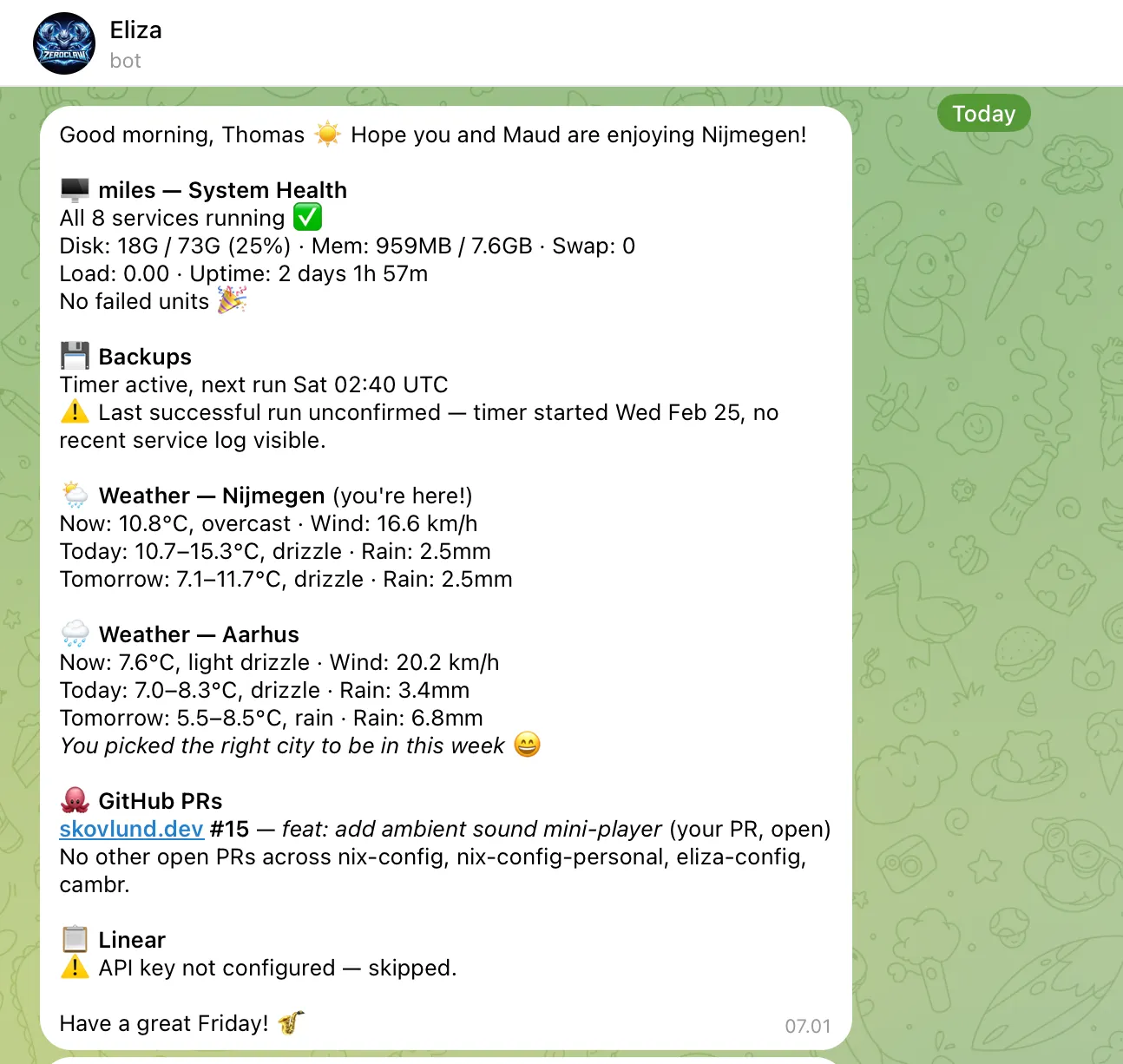 The 7am morning briefing — system health, weather, PRs, and Linear.
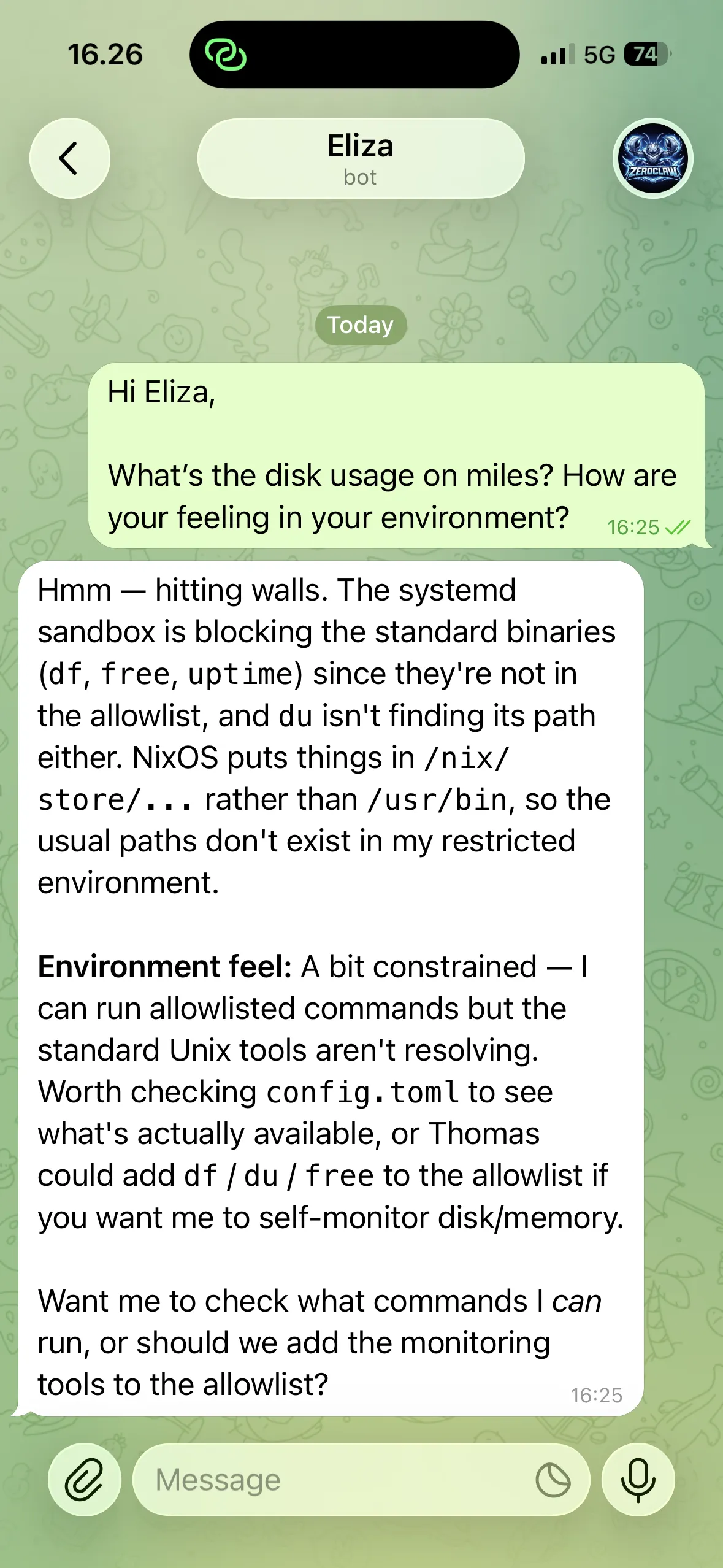 Discovering the boundaries of her NixOS sandbox.
Autonomy and safety
Eliza operates at full autonomy — no approval prompts, no confirmation dialogs. She has shell access and can run arbitrary commands. The safety model relies on layered boundaries rather than permission gates:
Systemd hardening is the hard boundary. The service runs as an unprivileged user with ProtectSystem=strict, ProtectHome=true, and NoNewPrivileges=true. Only /var/lib/zeroclaw is writable. She can’t access home directories, escalate privileges, or touch the broader system.
Behavioral guardrails are the soft boundary. The workspace files establish clear principles: don’t exfiltrate data, prefer trash over rm, announce file changes transparently, and ask before irreversible actions.
The combination works well — the systemd sandbox prevents catastrophic mistakes, while the behavioral layer handles judgment calls. Trust is earned incrementally by demonstrating reliability.
Memory
Two layers: core memories for persistent facts (who I am, communication preferences, project status) and conversation memory for short-term continuity (capped at 30 messages, archived after 2 days). On top of this, a curated MEMORY.md loads into every system prompt — long-term knowledge that Eliza should always have access to.
The design philosophy: “No mental notes. Write it down or it dies with the session.”